The art of mooncake making reaches its zenith not in the baking, but in the quiet, patient week that follows. This crucial period, known as the oil-returning process, is where the alchemy of texture and flavor truly occurs. While the golden-brown pastries emerge from the oven looking complete, they are, in fact, only halfway to their destined glory. The true magic unfolds away from the heat, in the cool, dark confines of storage, where sugar, oil, and time conspire to create a sublime confectionery experience.
At the heart of this transformation is the sugar syrup, the very soul of the mooncake's crust. This is not mere granulated sugar but a carefully cooked syrup, often infused with lotus seed paste or other complex flavors, which acts as both a sweetener and a humectant. During baking, the intense heat drives moisture out, concentrating the sugars and setting the structure. However, the crust at this stage is often firm, slightly dry, and can have a brittle quality, lacking the soft, yielding tenderness that defines a perfect mooncake. It is a canvas waiting for its final, masterful strokes.
The moment the mooncakes are removed from the oven, a reverse migration begins. The moisture, once driven to the center, now starts a gradual journey back outward. Simultaneously, the oils from the filling—be it from rich egg yolks, nut pastes, or lard within the dough—begin to slowly seep and redistribute throughout the pastry matrix. This dual movement is the essence of "oil returning." It is a process of rehydration and fat redistribution, where the crust, once parched, eagerly soaks up the migrating moisture and fat, softening and becoming pliable. The sugar syrup, now rehydrated, begins to work its magic, breaking down and converting over time, its crystalline structure softening to create a glossy, tender crumb.
This is not a quick fix but a slow, deliberate chemical conversation. The prescribed seven days are not an arbitrary number plucked from tradition; they are a biological and chemical necessity. Within this week, a complex series of reactions occurs. The sucrose in the syrup undergoes inversion, breaking down into simpler sugars like glucose and fructose. This inversion is critical because these simpler sugars are far more hygroscopic—they attract and hold onto water molecules with greater affinity. This increased water retention is what ultimately gives the mooncake its characteristic moist, soft, and slightly sticky texture that clings pleasingly to the palate. Rushing this process is futile; it cannot be accelerated by heat or mechanical means without fundamentally altering the desired outcome. The conversion of sugars and the even permeation of oils simply demand time.
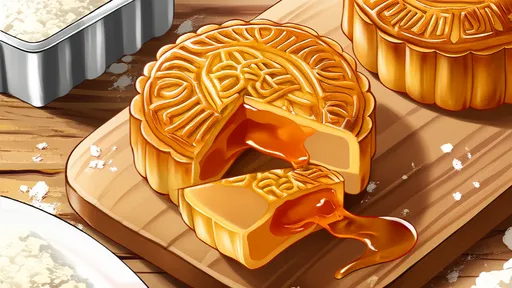
The result of this patient waiting is a textural revelation. A mooncake that has completed its oil-returning process is utterly transformed. The crust, once hard and crumbly, becomes tender, soft, and slightly chewy, yielding effortlessly to the bite. It melds seamlessly with the filling, no longer a separate entity but a harmonious component of the whole. The flavors, once distinct and sharp, have also mellowed and married. The richness of the egg yolk infuses the pastry, the sweetness of the syrup deepens and complexifies, and any spices or notes from the filling become uniformly distributed, creating a unified and profound taste profile. The sheen on the surface deepens to a rich, mahogany glow, a visual promise of the luxury within.
This week-long anticipation is a testament to a philosophy that values depth and maturity over instant gratification. In a world of fast food and immediate results, the mooncake stands as a beautiful anomaly. It teaches a lesson in patience, demonstrating that the finest things often require a period of rest and transformation away from the spotlight. The baker’s work is done, and now it is time for nature and chemistry to take over. To cut into a mooncake before its seven-day journey is complete is to experience only a shadow of its potential—a dry, disjointed, and underwhelming version of what it is destined to become.
Therefore, when the Mid-Autumn Festival arrives and the mooncakes are finally unwrapped, their perfection is a celebration of this hidden, silent week of transformation. Each soft, fragrant bite is the culmination of careful craftsmanship and respectful patience. The oil-returning process is the silent, essential partner to the baker's fire, the final, indispensable step in achieving the sublime texture and integrated flavor that makes a mooncake not just a food, but a cultural icon and a sensory masterpiece. It is a delicious reminder that true excellence cannot be rushed.
By /Aug 20, 2025
By /Aug 20, 2025
By /Aug 20, 2025
By /Aug 20, 2025
By /Aug 20, 2025
By /Aug 20, 2025
By /Aug 20, 2025
By /Aug 20, 2025
By /Aug 20, 2025
By /Aug 20, 2025
By /Aug 20, 2025
By /Aug 20, 2025
By /Aug 20, 2025
By /Aug 20, 2025
By /Aug 20, 2025
By /Aug 20, 2025
By /Aug 20, 2025
By /Aug 20, 2025
By /Aug 20, 2025
By /Aug 20, 2025
