In the bustling world of street food and quick bites, few items capture the imagination and appetite quite like the egg burger. A harmonious blend of fluffy batter, savory fillings, and that quintessential egg center, it’s a treat that seems simple on the surface but demands precision in execution. Among the many factors that dictate its success, one stands out as particularly crucial: the timing of pouring the batter into the mold. This moment, often overlooked by amateur cooks, is where the battle for the perfect egg burger is won or lost.
Mastering the pour isn’t just about following a recipe to the letter; it’s about understanding the alchemy happening in your mixing bowl. The batter itself is a delicate ecosystem. Too thin, and it will seep out of the mold, creating a messy, uneven base. Too thick, and it won’t cook through properly, leaving you with a doughy, undercooked interior that fails to complement the soft egg. The ideal consistency is that of a slightly thick, pancake-like batter that coats the back of a spoon but still drips off slowly. This is your canvas. But a perfect canvas is useless without perfect application.
The temperature of your cooking surface is the first variable that dictates your pour timing. A pan that’s not hot enough is a silent killer of potential. Pouring batter onto a lukewarm surface means it will spread too much before it begins to set, losing its defined circular shape and becoming thin and lacy at the edges. Conversely, a pan that’s scalding hot will cause the bottom to set and burn almost instantly, trapping uncooked batter on top and preventing a proper rise. The sweet spot is a medium heat where a flick of water sizzles and evaporates quickly but doesn’t dance around violently. You achieve this consistency, you wait for that specific sizzle, and then you commit.
And commit you must, with confidence and speed. Hesitation is the enemy of structure. The act of pouring shouldn’t be a timid drizzle but a swift, decisive action. Start from the center of the mold and pour in a steady, circular motion outwards until the mold is filled just to the rim. This technique ensures an even distribution, preventing thick, doughy mounds in the center and thin, brittle edges. The batter should immediately begin to bubble slightly around the very edges where it meets the hot metal—a sign that the cooking process has begun correctly. This is the point of no return. Within those first few seconds, the fate of your burger base is sealed.
But what about the mold itself? Its role is passive yet pivotal. A cold mold will shock the batter, hindering its ability to cook evenly from the bottom up. Therefore, the mold must be preheated along with the pan or griddle. A hot mold ensures that the batter starts cooking the very nanosecond it makes contact, seizing its form and creating that desirable slightly crispy outer ring. The material of the mold matters, too. Traditional cast iron holds heat magnificently, providing consistent, radiant warmth that cooks the batter uniformly. Non-stick rings are easier to handle but may require a slightly adjusted heat setting. Knowing your tools is part of knowing your timing.
The next critical intersection of time is the window between pouring the base batter and adding the egg. This is a dance of partial set. Pour the egg too soon, and its weight and moisture will sink into the still-liquid batter, causing it to bleed underneath and creating a fused, soggy layer instead of two distinct strata. Wait too long, and the base will have set completely, forming a barrier that the egg cannot integrate with, leading to a separation where the egg can easily slide out after cooking. The perfect moment is when the surface of the poured batter has just lost its wet, glossy sheen and is matte but still visibly uncooked in the center—usually 45 to 60 seconds for a standard-sized mold. At this precise juncture, crack your egg directly into the center.
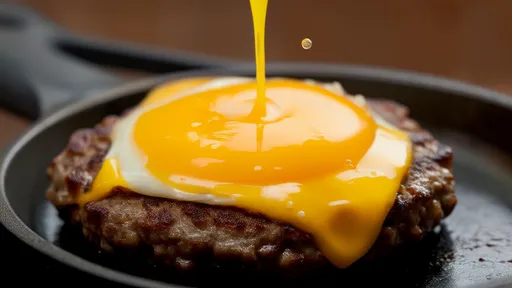
The egg addition introduces a new element: moisture and fat. As the egg white hits the partially set batter, it should sizzle gently and immediately begin to turn opaque from the bottom up. The yolk, a proud sun in the center, will remain gloriously runny for now. This is the signal to swiftly cover the pan if you haven’t already. The trapped steam is now your best friend, performing a delicate ballet of cooking. It gently finishes setting the top layer of the batter while simultaneously cooking the egg white through without overcooking the yolk. This stage typically takes another two to three minutes. The steam works its magic, melding the flavors and textures without direct, harsh heat.
Uncovering the pan reveals the final test. The edges of the batter should be golden brown and pulling slightly away from the mold. The egg white should be fully set, and the yolk should still jiggle enticingly. The final flourish, a flip, is optional but recommended for those who prefer a fully set yolk. This flip requires its own burst of courage and timing. Use a sturdy spatula to swiftly and cleanly invert the entire assembly. Thirty seconds to a minute on the other side is all it needs to seal the deal, creating a perfectly cooked, self-contained package.
The culmination of all this precise timing is a thing of beauty. The first bite offers a symphony of textures: the slightly crisp, golden-brown exterior of the batter giving way to its soft, cake-like interior, which in turn yields to the creamy, rich burst of the egg yolk. It’s a handheld masterpiece. Every second of delay, every moment of heat management, and every decisive pour contributes to this final experience. It transforms the act of cooking from mere following of instructions into an intuitive art form, a conversation between the cook, the ingredients, and the heat.
Ultimately, the perfect egg burger is not found in a list of ingredients or a set cooking time. It is born in that fleeting, critical moment when batter meets metal. It’s a testament to the fact that in cooking, as in many things, timing isn’t everything—it’s the only thing. Mastering this moment elevates a simple snack into a culinary achievement, a perfect bite crafted not just by hand, but by impeccable instinct and clockwork precision.
By /Aug 20, 2025
By /Aug 20, 2025

By /Aug 20, 2025
By /Aug 20, 2025
By /Aug 20, 2025
By /Aug 20, 2025
By /Aug 20, 2025

By /Aug 20, 2025
By /Aug 20, 2025

By /Aug 20, 2025

By /Aug 20, 2025
By /Aug 20, 2025
By /Aug 20, 2025
By /Aug 20, 2025
By /Aug 20, 2025
By /Aug 20, 2025
By /Aug 20, 2025

By /Aug 20, 2025
By /Aug 20, 2025
By /Aug 20, 2025
